Copper Centurion Cover Art Reveal

Cover Art for Copper Centurion is out! Check it out and learn more about the progress of my kickstarter campaign!


Happy Long Weekend everyone!

Hopefully people are out enjoying their long weekend, but if you are stuck at home (or, like me, poor, grading work, and stuck at home) then take a moment to check out the cover for Copper Centurion. I’m really excited to be bringing this to you. Those of you who look closely may spot some clues to some parts of the story! But I’m not giving any more clues!

Continue reading “Copper Centurion Cover Art Reveal”

What is Kickstarter?

What is Kickstarter, and how does it work?


Hi all,

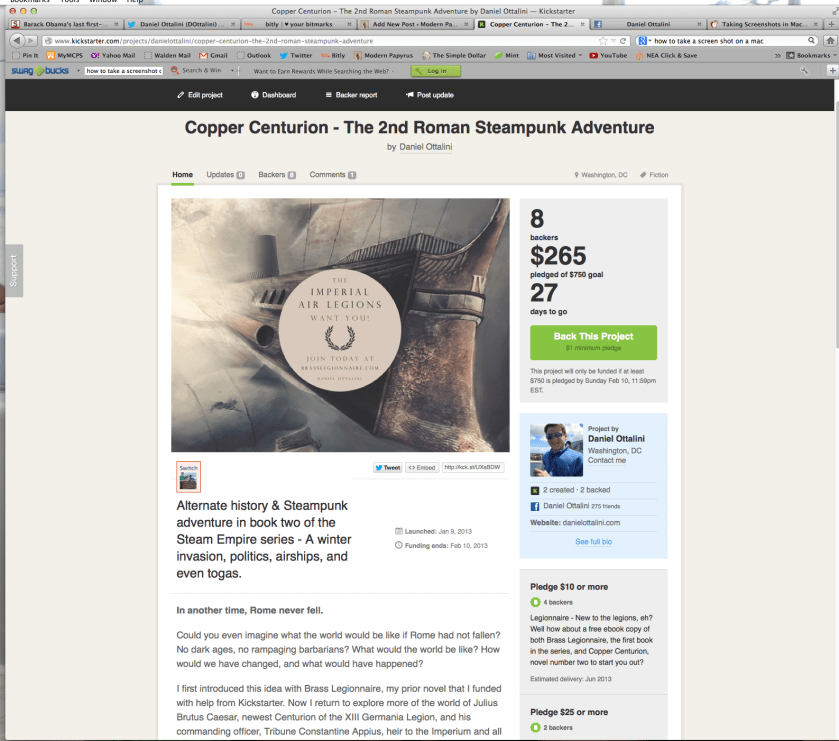
Hopefully by now, you’ve had a chance to check out my latest Kickstarter project and hopefully support me in my bid to publish Copper Centurion, the 2nd book of the Steam Empire Chronicles. I had quite a few people ask me in the last few days exactly what Kickstarter was! So prepare for a whirlwind tour of Kickstarter Nation.

What is Kickstarter?

Kickstarter is a funding platform for creative and awesome projects. This means that people looking to get a start in creating or producing something will find a home among the hundreds of thousands, if not millions, who support projects on kickstarter.

From the Kickstarter Website –

Everything on Kickstarter must be a project. A project has a clear goal, like making an album, a book, or a work of art. A project will eventually be completed, and something will be produced by it.

So what is the catch? Two actually. The first catch is that each project must be funded fully or beyond. So if you ask for $500 dollars, and only get $499, you get no money, zip, zilch, nadda. Which is good and bad. It doesn’t leave ‘partial’ projects hanging in limbo as creators try to secure other fundraising sources. The second catch is that each project creator must build reward tiers for each level of sponsorship. Pledge ten dollars to my project? You get a copy of both Brass Legionnaire and Copper Centurion ebooks. So in return for your money upfront, I give you a copy of what I’m working on (or have already finished). The rewards go up as the money goes up. I’ve seen people offer major characters in video games as rewards, names for product lines, given producer credit on albums, etc. Screen Shot 2013-01-14 at 9.49.21 PM

The only limits are pretty obvious – no weapons, no bribing (money for money or coupons for money) along with other banned substances. Kickstarter has more information, but really, be creative! My favorite tiers are the two highest because the rewards are the coolest! If you pledge $100, you get to create and name a character in Iron Tribune, my next full-length novel, and you can even choose his/her death. Of course, if you want something even cooler, you’ll pledge $250, which nets you all that plus a Roman Helmet. A legit helmet, not something you find in the dollar store.

But I digress. So rewards are the bread and butter of Kickstarter, but how to get rewards?! You must make your project cool. Kickstarter recommends making a video to promote your project. I plan on doing this, but the weather and light have not been cooperative, argh! But it also helps to have a social network out in advance – twitter, facebook fanpage, or email listserv. Alternatively, you can hit up friends and family to support to.

So there you have it – create your project, tell people why you need their hard earned money, then create your reward tiers, promote and voila! Hopefully a fully funded project. Oh, did I mention the time limit? 45-60 days max! And you must deliver on your rewards. Oh, and Amazon takes 5% of the money doled out in processing fees. So be aware, but then continue on! If there’s anything I learned, it is to start small – ask for $250 to help you get illustrations for your novel. Then see where it takes you!

Have any of you used Kickstarter? How did you like it? Were you successful?

Ciao!

Kickstarter Launch for Book Two

A new Kickstarter Campaign has been launched for Copper Centurion! Take a moment to read more and consider contributing to my second novel!


Greetings everyone!

It is with great excitement that I launch my second Kickstarter campaign, aimed at helping me fund book two of the Steam Empire Series, Copper Centurion. There’s some awesome rewards up for contributing, and I’ve really thought hard about what people would like to see from me as a reward.

To be blunt, at first I really did not want to use Kickstarter. I’d gotten help on the first novel, and wanted to really pay off all my followers by doing it all on my own. But the truth is, I need your help. A lot has changed in the past year for me, and the funding from Kickstarter will truly help improve the overall design, formatting, and feel of the novel. The cover art is already in progress, as is the editing, so the timing here is critical.

The funding will help defray the costs of editing, formatting, artwork. With Kickstarter money, I can add more illustrations and maps to the final novel. I can also focus my time on typing up short stories for the rewards! With my last book, I raised about half the cost of the novel through Kickstarter. I’ve lowered it to just 1/3 this go around. So take a moment to consider a donation. The campaign runs through February 10th, so check it out!

Thanks again so much for your continued support. I truly appreciate it. You have helped me bring my dream to life, so thanks, for everything.

Carpe Diem,Daniel

Ten Things to Know about Writing Historical Fiction (Guest Post by Hazel West)

Ten Rules to follow when Writing Historical Fiction – A Guest Post by Author Hazel West


Hi all,

As part of her blog tour for her new novel, By Blood or By Bond, Author Hazel West is joining us to talk briefly about the world of Historical Fiction, something similar (but not the same) as my personal favorite genre – alternate history. Plus, I’m a sucker for a good Roman History novel. Enjoy!

Ten (Unnoficial) Things You Should Know About Writing Historical Fictionbutton
1. First off, it’s fiction. That means you can bend the truth a little bit if you want to. So if you can’t find that info you need, make it up. Or add a little alternate history or steampunk if you want.

2. The awesome things you have the chance to try out. Think of it: reenacting epic battles in your back yard (scaring the neighbors), playing around with swords, (and don’t forget jousting with your bicycle and a broom handle!) trying Roman recipes, a medieval feast, or having a traditional posh English tea. The possibilities are endless.

3. You get to write about all your favorite historical figures if you so choose! Think of it: your words in the mouth of such as George Washington, or Hannibal! Okay, that might be a daunting thing at times, but if you just go for it, I find it works out a lot better.

4. You’ll get to clear the library out of all the books on your topic, thus making everyone else very annoyed, probably. Just remember not to hurt your back carrying them all out of the library.

5. Read some historical novels about the same time period. No, not to copy other author’s work (that’s plagiarism!), but to get a feel for how things are described or how you might go about it. Smells, sounds, sights, of the time period. Also, it’s a good excuse to get a few fun reads in while you’re supposed to be doing research.

6. If possible, check out the historical sights you are writing about. If this isn’t possible, then watching documentaries or travel videos works too. Just don’t put too much faith in Hollywood, because most of the time historical films are NOT filmed on site.

7. Okay, I won’t lie, you’re probably going to butt heads with people who say your books aren’t accurate. If this happens, direct them to Number One.

8. You’ll have to do copious amounts of research. There’s going to be a lot of every day things you won’t know about when writing historical fiction. Obviously, your medieval peasant can’t just pop open a package of Poptarts for breakfast, and if you think they can, you have a lot of research to do. 30% of writing historical fiction is coming up with a story and characters, the other 70% is research, research, and more research! Do not neglect it, even if you don’t use it all.

9. As with every novel, you are going to have to do multiple edits and possibly even re-writes. But with historical fiction, comes the further fact checking. Maybe if you’re lucky, you can find a fellow writer or reader who knows a lot about your book subject too to read it over for you and tell you if everything is good and historically sound (within reason, that is). If they complain about that crucial, irreplaceable part of your book not being accurate, remember to refer them, once again, to Number One.

10. As with every book, Have Fun! Historical fiction is probably the most fun genre to research next to mystery writing (unless you do historical mysteries, of course!). I can’t tell you how many stories I’ve come up with while researching for one book and finding other things that would make fantastic novels. It might be harder work than writing something from your own time period, but I guarantee you, it’s an adventure all on it’s own and very rewarding in the end!

About the Author:DSCN1548

Hazel West lives in Florida where she spend a good bit of time writing historical fiction about brave men and women who have graced the pages of history, trying to bring more light to their legacies so readers of all ages will enjoy them.

Hazel’s favorite things/hobbies: Writing obviously, listening to and playing Irish and Scottish folk music, practicing with all eras and types of historical weaponry, GOOD COFFEE, reading of course, dark (dark) chocolate, sketching/painting, hats, scarves and boots, collecting little old-fashioned things of all kinds, buying books, and don’t forget dressing in period clothing!

You can find Hazel on her Blog, via twitter @artfulscribbler, or on Goodreads

Click onward to read a description and teaser of Hazel’s new novel, By Blood or By Bond.

Continue reading “Ten Things to Know about Writing Historical Fiction (Guest Post by Hazel West)”